

More support shown for First responder Medicare eligibility
During Police Week in Washington, D.C., the Police Officers Association of Michigan (POAM) met with members of Michigan’s Congressional Delegation to advocate for critical healthcare legislation aimed at supporting retired first responders. Representatives Jack Bergman, Tom Barrett, Debbie Dingell, Tim Walberg, and Lisa McClain were presented with POAM’s support for the “Expanding Health Care Options for First Responders Act” (H.R. 6147 / S. 3221).
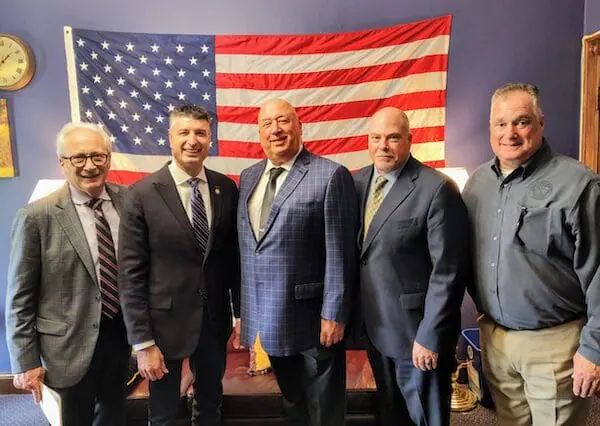 The proposed legislation would allow retired law enforcement officers and other public safety professionals to buy into Medicare beginning at age 50, helping bridge the healthcare gap many officers face after retirement but before traditional Medicare eligibility at age 65. Under the proposal, participating retirees would pay premiums based on a separate public safety risk pool while remaining eligible for tax credits and cost-sharing assistance.
POAM leadership emphasized that the issue of retiree healthcare has steadily worsened over the past 15 years as many collective bargaining agreements have eliminated or reduced retiree medical benefits. The result has created growing challenges for law enforcement agencies across Michigan and the country.
Many experienced senior officers are now leaving the profession earlier than expected, often before reaching full retirement eligibility, due in part to concerns surrounding healthcare coverage. According to POAM, this trend is creating a ripple effect throughout the profession regarding First responder Medicare eligibility.
Why This Matters to Law Enforcement Recruitment and Retention?
Loss of Experienced Officers
Departments lose some of their most seasoned officers — individuals who provide mentorship, institutional knowledge, and leadership for younger officers entering the profession.
Declining Recruitment Advocacy
Historically, veteran officers were among the strongest advocates for recruiting the next generation into law enforcement careers. As morale and long-term career stability decline, fewer officers are encouraging young people to enter the field.
Reduced Candidate Quality and Staffing Stability
While initiatives such as free police academies and increased starting wages are positive steps, POAM believes long-term career sustainability is equally important. The organization argues that restoring meaningful retirement and healthcare security will help attract candidates seeking law enforcement as a lifelong profession rather than a short-term occupation.
POAM President James Tignanelli noted that the legislation addresses “a very real and critical need” for public safety professionals who dedicate their careers to serving their communities.
The organization also reported encouraging conversations with Democratic lawmakers during Police Week discussions and acknowledged that bipartisan support from Republicans will ultimately be necessary for the legislation to advance.
POAM Pushes for Medicare Eligibility at Age 50 for First Responders
The Police Officers Association of Michigan is Michigan’s largest public safety and law enforcement organization, representing more than 14,000 front-line police officers, public safety personnel, and first responders across the state. The organization has long advocated for practical public safety legislation and officer protections at both the state and federal levels.
POAM encourages members and supporters to follow the progress of H.R. 6147 / S. 3221 as discussions continue in Congress.